A small town

I went to heaven,—
’T was a small town,
Lit with a ruby,
Lathed with down.
Stiller than the fields
At the full dew,
Beautiful as pictures
No man drew.
People like the moth,
Of mechlin, frames,
Duties of gossamer,
And eider names.
Almost contented
I could be
’Mong such unique
Society.

~Emily Dickinson
Mechlin lace via Wikimedia Commons

What fascinates me most about this poem is the depiction of heaven as a “small town.” Paradise is described in diminutive terms–it is illuminated not by a sun but “with a ruby.” Its people are described in terms of things soft, ephemeral, fairy-like. The Mechlin lace Dickinson mentions is very precise, painstaking, the images within it perfectly bordered and contained. Heaven sounds magical yet tiny, beautiful yet bound.

How are we to understand this smallness? Is heaven so exclusive? Is this a commentary on how many people could really get into it? Or is it a reflection of a different take on heaven? The speaker says she could be “almost contented” there–implying that she would never be perfectly content. Maybe heaven, as a single place, is constraining no matter what size it may be.

Except to heaven, she is nought

EXCEPT to heaven, she is nought;
Except for angels, lone;
Except to some wide-wandering bee,
A flower superfluous blown;

Except for winds, provincial;
Except by butterflies,
Unnoticed as a single dew
That on the acre lies.

The smallest housewife in the grass,
Yet take her from the lawn,
And somebody has lost the face
That made existence home!

Emily Dickinson

A short, necessary poem today to remind you of a short, necessary truth: if you were gone, you’d be missed. Not just by the being or people or thing you’re thinking about, either–something vital would be gone if you were lost, and that loss would be felt.

The Ocean

An everywhere of silver,
With ropes of sand
To keep it from effacing
The track called land.

~Emily Dickinson

A riddle–not even a complete sentence, but a suggestive fragment, in Dickinson’s characteristic painterly style with words. The ocean is an everywhere, a water planet, though we land-dwelling creatures tend to forget this. It is only a narrow band of sand that separates the realm of the mermaids from our own narrow track.

the Atlantic at twilight

July 5

Who never lost, are unprepared
A coronet to find;
Who never thirsted, flagons
And cooling tamarind.

Who never climbed the weary league—
Can such a foot explore
The purple territories
On Pizarro’s shore?

How many legions overcome?
The emperor will say.
How many colors taken
On Revolution Day? 

How many bullets bearest?
The royal scar hast thou?
Angels, write “Promoted”
On this soldier’s brow!

~Emily Dickinson

Because no revolution comes without a price.

A little patriotism from Emily Dickinson

My country need not change her gown,
Her triple suit as sweet
As when ’t was cut at Lexington,
And first pronounced “a fit.”

Great Britain disapproves “the stars”; Disparagement discreet,—
There ’s something in their attitude
That taunts her bayonet.

~Emily Dickinson

Happy Independence Day!

XXXIV

The Daisy follows soft the Sun
And when his golden walk is done
Sits shyly at his feet
He—waking—finds the flower there
Wherefore—Marauder—art thou here?
Because, Sir, love is sweet!

We are the Flower—Thou the Sun!
Forgive us, if as days decline
We nearer steal to Thee!
Enamored of the parting West
The peace—the flight—the Amethyst
Night’s possibility!

Emily Dickinson

Brenna:

It’s a charming poem. I love the imagery–the shy daisy (who’s nevertheless bold enough to address the sun/God). The “parting west” bit at the end calls to mind Frodo and Sam and the Grey Havens.

The part that mystifies me is the sun’s response to the daisy. “Marauder”? How is the daisy a marauder? Isn’t that what the sun/God wants–for the daisy to turn toward it? It’s a strange choice of words, especially for a humble little daisy described as “shy.” So that’s the part I don’t know what to do with. Is the sun teasing the daisy, or is it serious?

There also seems to be a message in here about the tendency of human nature to turn toward faith at the end of life and/or in times of difficulty rather than from the get-go, rather than consistently being faithful all along.

Another weird thing–why is the sun waking “when his golden walk is done”? Is it just me, or does that make zero sense??

Pam: The marauder bit is odd, isn’t it? This is something you’d say to somebody who’s stealing from you–somebody with malicious intent. This is a daisy, Mr. Sun! I suppose there is a transaction in their relationship, with the flower making use of sunlight, but it’s not like the daisy is some dastardly character who intends to defraud the sun.

I’m wondering if this poem is, at least partly, a play on movement. Maybe the daisy following the sun is growing taller; when it falls to lie at the sun’s feet, it could be drooping, the way some flowers do when the sun goes down? Or maybe the poor daisy just needs a drink.

I love the idea that the daisy wants to get closer to the sun to get at Night, that follows after–as you’ve mentioned in the idea of humans clinging to faith later in life. It’s a neat little conundrum we’re given: to get closer to night, you have to get closer to day.

This poem has left us with more questions than answers, hasn’t it?

Exultation

Exultation is the going
Of an inland soul to sea,—
Past the houses, past the headlands,
Into deep eternity!

Bred as we, among the mountains,
Can the sailor understand
The divine intoxication
Of the first league out from land?

~Emily Dickinson

First things first–mad props to Pam, who has been blogging solo this past week so that I could go to the beach without lugging my laptop along.

The beach, for me is really about the ocean, and this is probably my very favorite of Dickinson’s poems because it so purely and perfectly captures the essence of the wonder we landlubbers feel at the sight, sound, smell of the sea. Of course, we don’t all feel it. One of my grad school friends, born and bred in Kansas, said she hated the ocean. I have other friends who detest sand with such an incandescent loathing that they can’t enjoy the beach. But for us landlocked mermaids, the first glimpse of the sea is truly a divine intoxication.

During our vacation, my husband read a book about Highway 12, which links the Outer Banks. The author writes that

The Banks themselves, which stand as a barricade to the Atlantic, are composed of tiny bits of stone chiseled by time and weather from the faraway Blue Ridge Mountains. Carried to the location by rivers through the ages, these granules of quartz and feldspar are mixed there with the shattered remnants of shells of countless departed sea creatures whose only proof of existence lies in the blended residue called sand.

~Dawson Carr, NC 12: Gateway to the Outer Banks

Maybe this explains why I have always been drawn to this place, why it feels as much like home as the place of my birth. Bred among the Blue Ridge Mountains, maybe something deep within me recognizes that these barrier islands are relocated pieces of home.

Mother Nature

NATURE, the gentlest mother,
Impatient of no child,
The feeblest or the waywardest,–
Her admonition mild

In forest and the hill
By traveller is heard,
Restraining rampant squirrel
Or too impetuous bird.

How fair her conversation,
A summer afternoon,–
Her household, her assembly;
And when the sun goes down

Her voice among the aisles
Incites the timid prayer
Of the minutest cricket,
The most unworthy flower.

When all the children sleep
She turns as long away
As will suffice to light her lamps;
Then, bending from the sky,

With infinite affection
And infiniter care,
Her golden finger on her lip,
Wills silence everywhere.

An unworthy flower thanks the gentlest mother. Today, find something beautiful, and thank whoever needs thanking.

The Juggler of Day

BLAZING in gold and quenching in purple,
Leaping like leopards to the sky,
Then at the feet of the old horizon
Laying her spotted face, to die;

Stooping as low as the otter’s window,
Touching the roof and tinting the barn,
Kissing her bonnet to the meadow,–
And the juggler of day is gone!

Emily Dickinson

Prompt: look at the many ways Dickinson describes the sun. It’s a leopard and an otter; it’s actively doing lots of things: blazing, quenching, stooping, tinting, etc. What other animals can you use to describe the sun? What other things does it do?

On the bleakness of my lot

ON the bleakness of my lot
Bloom I strove to raise.
Late, my acre of a rock
Yielded grape and maze.

Soil of flint if steadfast tilled
Will reward the hand;
Seed of palm by Lybian sun
Fructified in sand.

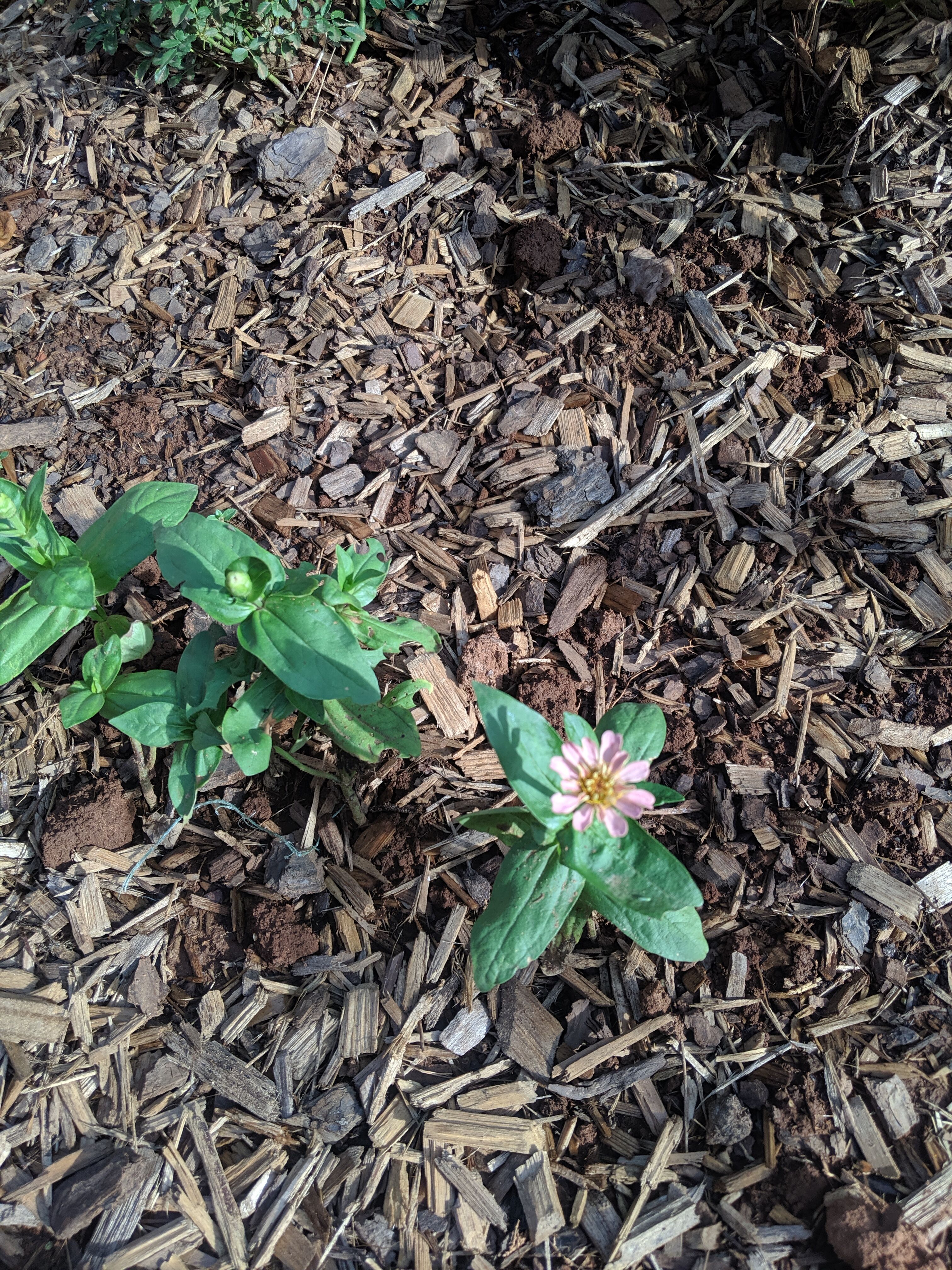
This is part of my bleak lot–but instead of grape and maize, I have marigold transplants from my mother-in-law’s garden. So amazed that they survived, grew, and bloomed, I had to take a picture to prove that I hadn’t killed them.

Steadfast? That’s not me, not about much. Rewarded, though: every day.