The poet in conversation with…herself?

If the foolish call them “flowers”,
Need the wiser tell?
If the savants “classify” them,
It is just as well!

Those who read the Revelations
Must not criticise
Those who read the same edition
With beclouded eyes!

Could we stand with that old Moses
Canaan denied,—
Scan, like him, the stately landscape
On the other side,—

Doubtless we should deem superfluous Many sciences
Not pursued by learned angels
In scholastic skies!

Low amid that glad Belles lettres
Grant that we may stand,
Stars, amid profound Galaxies,
At that grand “Right hand”!

~Emily Dickinson

“Faith” is a fine invention
For Gentlemen who see!
But Microscopes are prudent
In an Emergency!

~Emily Dickinson

The second of these poems was our March 14 choice. You can read that short and snarky post here. When I read today’s poem, the first of the two, it immediately reminded me of the second one. It’s interesting to find two of Dickinson’s poems that seem to approach the same subject from two very different viewpoints. I don’t think they’re irreconcilable, but I couldn’t resist putting them side by side for comparison. What do you think?

The Juggler of Day

BLAZING in gold and quenching in purple,
Leaping like leopards to the sky,
Then at the feet of the old horizon
Laying her spotted face, to die;

Stooping as low as the otter’s window,
Touching the roof and tinting the barn,
Kissing her bonnet to the meadow,–
And the juggler of day is gone!

Emily Dickinson

Prompt: look at the many ways Dickinson describes the sun. It’s a leopard and an otter; it’s actively doing lots of things: blazing, quenching, stooping, tinting, etc. What other animals can you use to describe the sun? What other things does it do?

On the bleakness of my lot

ON the bleakness of my lot
Bloom I strove to raise.
Late, my acre of a rock
Yielded grape and maze.

Soil of flint if steadfast tilled
Will reward the hand;
Seed of palm by Lybian sun
Fructified in sand.

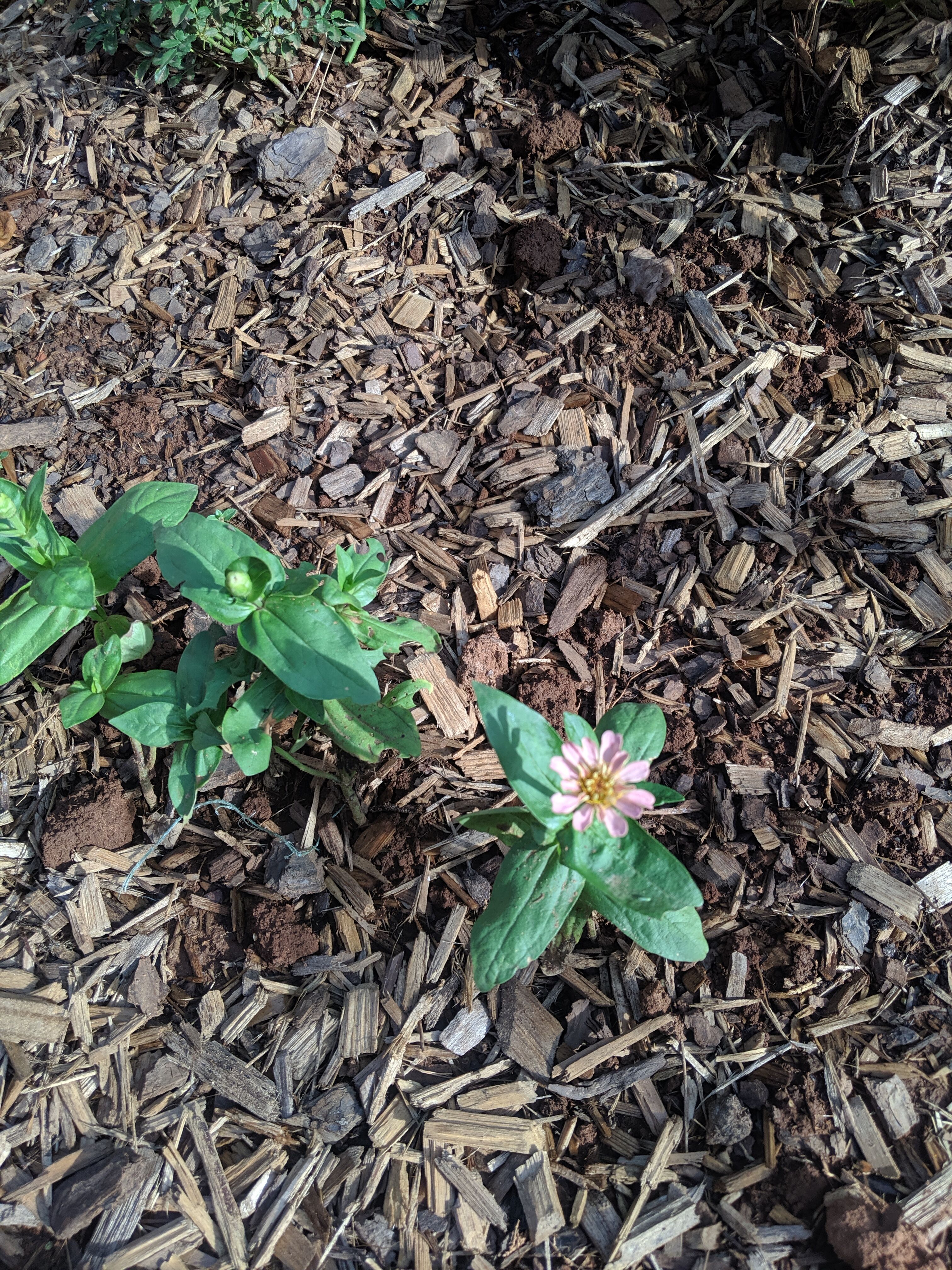
This is part of my bleak lot–but instead of grape and maize, I have marigold transplants from my mother-in-law’s garden. So amazed that they survived, grew, and bloomed, I had to take a picture to prove that I hadn’t killed them.

Steadfast? That’s not me, not about much. Rewarded, though: every day.

Renunciation

THERE came a day at summer’s full
Entirely for me;
I thought that such were for the saints,
Where revelations be.

The sun, as common, went abroad,
The flowers, accustomed, blew,
As if no soul the solstice passed
That maketh all things new.

The time was scarce profaned by speech;
The symbol of a word
Was needless, as at sacrament
The wardrobe of our Lord.

Each was to each the sealed church,
Permitted to commune this time,
Lest we too awkward show
At supper of the Lamb.

The hours slid fast, as hours will,
Clutched tight by greedy hands;
So faces on two decks look back,
Bound to opposing lands.

And so, when all the time had failed,
Without external sound,
Each bound the other’s crucifix,
We gave no other bond.

Sufficient troth that we shall rise–
Deposed, at length, the grave–
To that new marriage, justified
Through Calvaries of Love!

Emily Dickinson

Today, we have a long poem to tell you: Happy Solstice. How are you celebrating?

A wounded deer leaps highest

A WOUNDED deer leaps highest,
I’ve heard the hunter tell;
‘Tis but the ecstasy of death,
And then the brake is still.

The smitten rock that gushes,
The trampled steel that springs:
A cheek is always redder

Just where the hectic stings!
Mirth is the mail of anguish,
In which it cautious arm,
Lest anybody spy the blood
And “You’re hurt” exclaim!

Emily Dickinson

This is the “I’m fine” of poems.

“How are you?” asks the cashier, your aunt, a friend.

Here is what you say: “I’m fine.”

Here is what you want to say: “I’m worried about my job. My kids aren’t sleeping at night. There are five chipmunks digging up all of my gladiolus bulbs and I spent money on those things and I am beyond irritated. I have a new mole and I’m afraid. That root canal is going to be expensive. I don’t know when my next paycheck is coming. I would rather eat a hundred raw worms than cook supper tonight. I’m hurting. I’ve been depressed for a while but I’m not telling anybody about it. Today has been hard and tomorrow will be harder.”

You smile and say that you’re fine.

Has Emily not hit the nail on the head here? Why is “mirth . . . the mail of anguish” unless it’s because we think we can disguise sadness with a fake smile?

Why are we still doing this?

My goal for us is to no longer be that deer, that steel, that smiling cheek. Let’s be honest.

Presentiment

Presentiment is that long shadow on the lawn
Indicative that suns go down;
The notice to the startled grass
That darkness is about to pass.

~Emily Dickinson

Such a small yet fascinating poem. The first thing we read, that unwieldy first line, mimics the length of the shadow on the lawn. This line is twelve syllables, while the remaining three lines have only eight syllables each. They are all perfectly matched, the last two even rhyming in a true rhyme with “grass” and “pass.” I love when poems do this–when their structure somehow mirrors their subject matter. “Presentiment” itself is a long, unwieldy word, and perhaps presentiment itself is an unwieldy, awkward thing–what do we do with our presentiments, if we have them? What do we make of them? How do they affect us? Are they even real?

I’m not sure why the grass is startled. Doesn’t it know to expect the passing darkness? It’s not as if it’s never happened before or will never happen again. The very notion of presentiment being connected to the setting of the sun is strange–of course the sun goes down. It does this every day. It’s not a presentiment if we know it’s going to happen.

But Dickinson is, of course, dealing in metaphor. Presentiment is symbolized by that long shadow, the stretching shade that tells us that something else, something different, is on its way. Darkness follows light.

In the final line, “darkness is about to pass.” This is a rich choice of words. On the one hand, darkness is about to pass over–it’s about to happen. But on the other hand, the choice of “pass” conveys a sense of motion, a certainty that, no matter what, the darkness is not forever. This, too, shall pass.

In which Pam reads the poem backwards, but to be fair, she is trapped under a sleeping child and typing one-handed

Did the harebell loose her girdle
To the lover bee,
Would the bee the harebell hallow
Much as formerly?

Did the paradise, persuaded,
Yield her moat of pearl,
Would the Eden be an Eden,
Or the earl an earl?

~Emily Dickinson

Brenna: Do you have any thoughts about the racy bee poem?

Pam: What is a harebell?

Brenna: A flower.

Pam: Only that this sounds like it was intended to be a tongue twister and I’m having trouble unpacking it!

It’s pretty!

Brenna: It is! It looks like bluebells.

I feel like all she’s saying is that if the harebell was easy to get, the bee would not appreciate it as much? I don’t know…do bees appreciate? I mean, bees are amazing, but I feel like she’s putting a LOT on them here. They seem like a stand-in metaphor for her…but for what? Humans in general?

Pam: Ooooooh that makes sense!!! I was reading it backwards and so confused!!

Brenna: LOL Backwards would definitely make it a tongue twister!

Pam: Right? But bees and flowers have a transactional relationship

Pathetic fallacy, Emily

Brenna: Yes! But she writes about them as if they don’t. As if bees are these lecherous parasites. But TBH she thinks bees are dudes, so there’s that.

Pam: What’s up with the earl?

Brenna: No. Idea. I get the heaven bit. If heaven was easily obtainable, would it really be heaven? But the earl….??? Is “earl” a metaphor for something of worth? I feel like she’s pushing really hard for the rhyme, which is weird because hello, Emily Dickinson, Queen of the Slant Rhyme.

Pam: Right?? Tongue twister. Or a pointed jab at someone.

Brenna: Ah! Maybe! Wasn’t there an earl in another one we read not too long ago? Or maybe I am making this up…Maybe she knew a guy named Earl??

Um, this is interesting: According to her, this is A Racy Poem. Also a feminist manifesto. And I have to say, as much as I love me a good feminist manifesto, I am having trouble as a feminist beekeeper going with this whole “bees as lecherous dudebros” metaphor.

Pam: Oh wow. Huh.

Brenna: Pam, can you imagine if Emily Dickinson had known that worker bees are all female? It would have BLOWN HER MIND. And changed half her poems.

Pam: I feel like this one might deserve a pic of a bee on a flower and that musing.

Brenna: LOL

Pam: How would her poems have changed if she’d known???

Brenna: She couldn’t have used bees as a metaphor for creepsters, for starters! And I wonder whether she’d have still used them to symbolize God in other poems. I feel like she’s maligning bees. Poor bees never did anything to Emily Dickinson. Unless she got stung a lot. Even so. Maybe she got burned by a beekeeper.

Pam: Maybe she was allergic to honey. Or hated the smell of beeswax candles.

Brenna: Is that even possible?

Pam: I don’t know.

Brenna: Should we call it a day? I am tempted to just copy/paste this whole convo without editing.

Pam: Do it. It’s perfect.
Prompt: Sunset

Where ships of purple gently toss
On seas of daffodil,
Fantastic sailors mingle,
And then–the wharf is still.

Emily Dickinson

This one is short and sweet, and above all else, I can see it. We’re watching a sunset, and the sun is just a slit of yellow over the horizon; purple is descending. In the last fading sunlight, long shapes of color thin out and change hues and, at last, disappear.

For today’s prompt, consider answering the following question in your own way, in your own poem: how else is a sunset like a body of water? What kind of feelings do the two evoke?

More bees!

Come slowly – Eden!
Lips unused to Thee –
Bashful – sip thy Jessamines –
As the fainting Bee –

Reaching late his flower,
Round her chamber hums –
Counts his nectars –
Enters – and is lost in Balms.

~Emily Dickinson

I couldn’t find anything that seemed appropriate for Father’s Day, so here is a picture of a bee and yet another Dickinson poem that mentions bees. Because you can never have too many bees.

drunk on summer

I TASTE a liquor never brewed,
From tankards scooped in pearl;
Not all the vats upon the Rhine
Yield such an alcohol!

Inebriate of air am I,
And debauchee of dew,
Reeling, through endless summer days,
From inns of molten blue.

When landlords turn the drunken bee
Out of the foxglove’s door,
When butterflies renounce their drams,
I shall but drink the more!

Till seraphs swing their snowy hats,
And saints to windows run,
To see the little tippler
Leaning against the sun!

~Emily Dickinson

It’s easy to be drunk with summer these days. Though it’s not technically summer yet, schools are out, gardens are bursting into bloom, and the air is full of the golden trajectories of honeybees. Here in the north of the South, we’re having perfect weather–warm but not hot, balmy breezes, blue skies punctuated by puffs of white cloud.

It won’t last–it never does. We’re typically in a drought by August, and before that, temperatures have become wretchedly hot and the air is humid. It’s hard to sleep at night with the windows open.

But for now, we are living in a temperate paradise. The soft wind carries the scent of sun-warmed pines through the screen, and in the evenings, the crystalline song of a wood thrush traces invisible lines of silver through the perfumed air. Impossible not to be drunk on summer these days. It’s best to just sink into it.