Happy Valentine’s Day!

We think we’ve found it at last–an Emily Dickinson love poem that’s actually about love and not secretly about death! Enjoy!

XXIX


The rose did caper on her cheek,
Her bodice rose and fell,
Her pretty speech, like drunken men,
Did stagger pitiful.


Her fingers fumbled at her work,—
Her needle would not go;
What ailed so smart a little maid
It puzzled me to know,


Till opposite I spied a cheek
That bore another rose;
Just opposite, another speech
That like the drunkard goes;


A vest that, like the bodice, danced
To the immortal tune,—
Till those two troubled little clocks
Ticked softly into one.

~Emily Dickinson

A taxonomy of love poems

~Emily Dickinson

For some reason I could not get this poem to format no matter what I tried; thus, the picture. It seems appropriate–this poem seems to defy conventional formatting in a number of ways.

It’s a strange little poem, but then, that seems to be par for the course here. I’m not sure what’s going on with the sudden use of Scots dialect in the third line. Like many (most?) of Dickinson’s poems, though, it ends with an image of decay/death, so that’s not unexpected.

The poem seems pretty straightforward, as many of her love poems do. As we work our way through this month of love poems, I’m starting to think that all Emily Dickinson love poems fall into one or more of several categories:

  • love poems that address her little heart;
  • love poems about being married that sound vaguely ominous;
  • love poems that depict passion in terms of cold rather than heat;
  • love poems that rely on some pretty obvious metaphorical language about bees and flowers;
  • love poems that end in death;
  • love poems with a rhythm/rhyme scheme that somehow feels vaguely embarrassing to read;
  • love poems about the inaccessibility of the beloved; and
  • love poems that may or may not be love poems, but somebody decided to anthologize them as such.

We’re almost halfway through this short month of Emily Dickinson love poems, and there’s much more to read, so we’ll see if we need to add to this list as we go along. Perhaps we can create a taxonomy of Dickinsonian love poetry…

In which we are not sure whether this is actually a love poem:

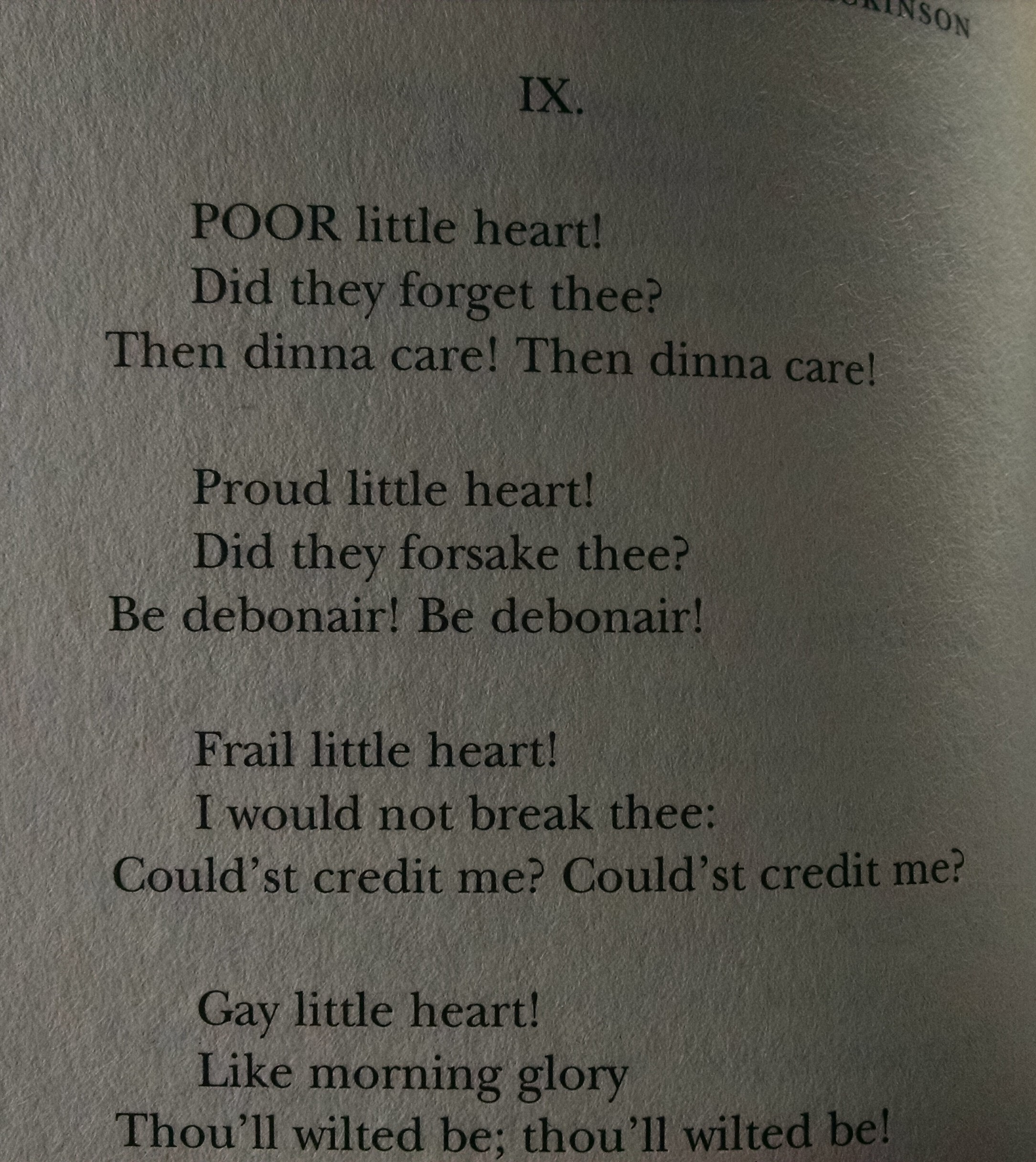
IX


Have you got a brook in your little heart,
Where bashful flowers blow,
And blushing birds go down to drink,
And shadows tremble so?


And nobody, knows, so still it flows,
That any brook is there;
And yet your little draught of life
Is daily drunken there.


Then look out for the little brook in March,
When the rivers overflow,
And the snows come hurrying from the hills,
And the bridges often go.


And later, in August it may be,
When the meadows parching lie,
Beware, lest this little brook of life
Some burning noon go dry!

~Emily Dickinson

Brenna, haphazardly choosing today’s poem: On page 18, IX strikes me as kind of a weirdo one.”Have you got a brook in your little heart.” WHY DOES THIS MAKE ME LAUGH

Pam: Let me flip over. I’ve lost my book. Give me a minute!0

Brenna: I shall paraphrase for you thusly: Your love is a little brook. It is smol and secret. But in March WATCH OUT, PASSION and other things polite nineteenth-century ladies only speak of via euphemism. But then by August, your love is dried up and DEAD and everything Emily Dickinson writes is about DEATH.

Pam: Oh my goodness. Flipping over now.

Brenna: I may be feeling a little punchy…

Pam: I think punchy is the right way to approach this one.”Have you got a brook in your little heart” Emily what even. Everything is bashful and blushing and trembling!

Brenna: Usually she reserves “little” as an epithet for herself, but here it’s second person. But I still get the feeling she’s talking to/about herself.And if you don’t watch out, you will be Overcome! And then die.When your love is in full flood, it will take out bridges!! Beware!!

Pam: I absolutely think she’s talking about herself, and that’s what cracks me up the most. It’s disguised to look humble and it’s doing the exact opposite. Look at me, I am so dainty and I have this very tiny love, which I am shouting about in a poem!

Brenna: YES. My love is very smol and cute and dainty, but then it gets huge and ragingly powerful and it will TAKE YOU DOWN. And then it dies.

Pam: Are you also reading the torrents of March as just inexpressibly huge lust? Is that just me? I’m honestly equating this with the animals going twitterpated in Bambi. Spring = birds and bees!

Brenna: I am reading this exactly the same way. Spring=innocent puppy love. March=lust. It will destroy you and everything else in its path. August=you are OLD and DRIED UP and love is no longer for you. So there!!

Pam: Exactly!!We have the cold in this poem, too! The snows hurrying from the hills. What were you saying about cold in Dickinson’s poems?

Brenna: Cold=passion. Aha!! It still holds true! My Cold Theory of Dickinson!!

Pam: It’s an I Am Very Special poem.

Brenna: It is! It strikes me that rather a lot of her poems are “I Am Very Special” poems. Like Poe, who wrote that from earliest childhood he was totally and completely unlike anyone else. There is so freaking much exceptionalism in poetry. Maybe just American poetry?? Or maybe white people poetry…

Pam: I honestly think it’s just a poet characteristic. I’m not going to say I’m also like that, but I’m also like that. I think if you didn’t have such an inflated sense of self-worth, you’d probably choose a saner career than poet.

Brenna: Is that why we write? Then how do we explain the constant and crippling self-doubt?? She had it too! Why are we paradoxes???

Pam: I think being a writer makes one automatically a parodox. So what do we do with this wilting flower?

Brenna: Hmmm…..Well, let me ask you this– Do you have a brook in YOUR little heart, hmm? Why is this even in the “Love” section? We’re only assuming it’s love because it’s in that section, but this could be ANYTHING. I don’t know what to do with this weirdo poem. Maybe we post it along with a single question–what on earth does she mean??

Pam: Oh, goodness. I don’t have a brook in my heart. My heart is composed primarily of lost socks and pizza.

Brenna: I want to laugh and cry at the same time, that is so true. Lost socks and pizza….yes….It’s the freaking METER. The meter is what makes this poem so very especially weird. Meter and rhyme scheme. It sounds like one of those horrible poems written just to rhyme.

Pam: YES. The poem bends itself in knots to fit the rhyme.

At this point, dear reader, we just gave up.

XIII – HEART, we will forget him!

HEART, we will forget him!
You and I, tonight!
You may forget the warmth he gave,
I will forget the light.

When you have done, pray tell me,
That I my thoughts may dim;
Haste! lest while you’re lagging,
I may remember him!

Emily Dickinson

I adore this little nugget of a poem. Not because I think there’s anything special going on here; there’s no thread of hidden knowledge I plan to tease out. This is a breakup poem, pure and simple, and I love the absolutely done-ness of that opening line: we don’t need him, anyway!

However, it’s an Emily Dickinson breakup poem. This means that we have to deal with the narrator speaking to the heart as though it’s a separate entity; as though head and heart must both forget the object of their affection. It makes sense. In high school, I dated a boy for around three years, and when we broke up, my heart was done but my brain hadn’t gotten the memo yet. I must have picked up the phone to call him half a dozen times–we talked on the phone every night, bless the late 90s–before breaking that habit.

It wasn’t that I wanted to talk to him; I didn’t. I was just so used to the motion that my brain kept trying to repeat that same pattern.

The narrator here seems to have a slightly more complicated problem. She’s asking the heart to forget, and to let her know when that’s done–because if it’s not soon, the narrator is going to remember him. Is this an inevitability, then, since head and heart don’t seem to be on the same wavelength?

For what it’s worth, I’m not sure that this relationship is finished. Having to tell yourself that you’re going to forget a man seems less like Frodo taking the ring up Mount Doom, and more like Gollum hoarding his treasure in a deep cavern. Or, to put it more plainly: if Emily’d had a phone, she might have dialed this gentleman’s digits before she finished blotting the ink on this poem.

“The fathoms they abide”


 Full fathom five thy father lies; 
              Of his bones are coral made; 
    Those are pearls that were his eyes: 
              Nothing of him that doth fade, 
    But doth suffer a sea-change 
    Into something rich and strange. 
    Sea-nymphs hourly ring his knell: 
                              Ding-dong. 
    Hark! now I hear them—Ding-dong, bell.

~William Shakespeare, The Tempest
Emily Dickinson

Today’s poem comes to you courtesy of my great-great-grandmother’s copy of Emily Dickinson’s poems. Yesterday my mom gave it to me. She had been going through her books, found this one, and thought I might like to have it. I had forgotten to tell her about this project, so it seemed a wonderful, magical coincidence.

The book is old, worn, obviously well-read. Its spine is completely missing. Any dust jacket it once bore is long gone (I wonder if that paper has rotted away into soil, its molecules alchemized into earth, blossoms, bees…)

New and old…

My great-great-grandmother’s name was Lucile Jansen Bower. A generation before her, my great-great-great-grandmother, wife of an authoritarian husband, walked into the Atlantic Ocean one day and did not return. Officially, she drowned. Her story, as it has come to be handed down over a century, ends with, “but she was a very strong swimmer.” The implication is that her death was not accident but escape. I read The Awakening in college, long before I ever heard this family tale, and the first hearing broke me out in cold chills, forever conflating Edna and my ancestor in my imagination.

I wonder what Lucile thought of as she read this poem. Did she hold it up against her own marriage as a woman holds a dress against her body to estimate the fit? Did she think of her mother-in-law and the fathoms she abided?

Emily Dickinson must have thought of Ariel’s song from The Tempest as she wrote these lines. The first stanza begins in rather ordinary fashion–girl becomes woman becomes wife. It all sounds solemn and expected. Then, the turn–in the second stanza, the telling “If.” If her life lacked awe, amplitude, if the gloss wore off–only if–then that lack is as unknown as the ocean’s depths. Why “if”? Why introduce the idea at all if it isn’t so? Dickinson implies that in her marriage, the wife is silent, silenced. This is an interesting poem to include among the sections of love poems in Dickinson’s work. The wife in the first stanza is like a caterpillar become butterfly. In the last stanza, the allusion parallels her with a dead man. Birth, new life, death. The more Dickinson I read, the more I marvel at her ability to make basically anything all about death.

When I stand at the edge of the Atlantic, I think of my great-great-great-grandmother. In an anachronistic imagined memory I see her, standing with her back to a continent. I cannot see her face. She looks out at the infinite expanse, monsters gliding beneath its unquiet surface. She understands that they are free.

If I could somehow stop her, would this change the course of history? In the second this thought takes to lodge in my brain she steps out into the surf, her skirts billowing around her, and strikes out, strong and confident, for the impossible horizon.

Sea-nymphs hourly ring her knell.

With a Flower

WHEN roses cease to bloom, dear,
And violets are done,
When bumble-bees in solemn flight
Have passed beyond the sun,

The hand that paused to gather
Upon this summer’s day
Will idle lie, in Auburn–
Then take my flower, pray!

Emily Dickinson

Both of my grandmothers were prolific gardeners, and so, apparently, was my great aunt Ruth. She died either the day before or after I was born–I’ve always loved that, and can never remember which is true–and my parents bought her house and we moved in when I was 2. She planted camellias absolutely everywhere, and they’re still there, bright hot pink lights in the winter.

My maternal grandmother, Maw-Maw, I remember more for her vegetable garden, but her blueberry bushes and peach trees are fresh in my mind (and in my tastebuds). My paternal grandmother, Grannie, had the most lovely red spider lilies outside her front window.

Maybe that’s why I don’t read this poem and immediately imagine it written to a lover. I think about the gardeners who lived before me, who planted things I still get to see, and I think about my daylilies in the front yard and the Felicia rose in the backyard that will, hopefully, live for a very long time. I hope that they’re still going after I’m gone.

When roses cease to bloom and bumblebees have flown beyond the sun–there must still be some flowers to gather, so I can’t think that Dickinson is imagining the end of the world. She’s still lying in repose, after all. Auburn, I’m supposing, is the city in Massachusetts, about an hour’s drive from Amherst. In typical Dickinson fashion, she’s telling us to take the flowers from her grave, I think. And I think my grandmothers would approve.

Elysium

IV


ELYSIUM is as far as to
The very nearest room,
If in that room a friend await
Felicity or doom.


What fortitude the soul contains,
That it can so endure
The accent of a coming foot,
The opening of a door!

~Emily Dickinson

Pam: Elysium can be really near if there’s a friend in it?

Brenna: This one is small yet fascinating. I don’t know what to make of this, but it’s interesting to me that the speaker poses two possibilities for the friend–“felicity or doom”–but only one for what that means to the speaker herself–“elysium.” What if the friend meets doom? This is the Schrodinger’s cat of Emily Dickinson poems–as long as you don’t know whether the friend is meeting felicity or doom, the room contains heaven. And doom. But heaven!

Pam: The speaker is in heaven because there’s a friend nearby. But there’s little regard for the friend’s situation.

Brenna: And how that affects the speaker. So very Emily. Heaven can be in the next room if the friend’s fate turns out well. But if not….she doesn’t offer the alternative. Perhaps it is too painful to consider.

Pam: And the second stanza seems to switch. Now it’s the friend enduring as they’re waiting for the door to open.

Brenna: Oh, I see how you’re reading it–if a friend is nearby, that’s heaven.

Pam: Yes! How do you read it?

Brenna: I read it as, “My friend is in the next room awaiting their fate. Heaven is possibly in that room–if all turns out well for them.” And I read the fortitude as hers while she waits to find out what will happen to the friend.

Pam: Oh, I see! Elysium is friend A going to comfort friend B, who is awaiting fate! That makes far more sense.

Brenna: I hate to say it, but either way she comes across as a bit of a jerk. It’s all about her.

Pam: She does! She’s fond of these tricky constructions, isn’t she?

Brenna: She does love her some convolution in tiny spaces. It’s very pat-myself-on-the-back. Humblebrag!! Emily mastered it long before social media. Reading an Emily Dickinson poem is like crawling around in a very tiny cave.

Pam: See, I read the fortitude as the friend’s awaiting the speaker.

Brenna: Oh, I read it as her waiting to find out–did the friend meet felicity or doom?

Pam: I love how we have such different readings for this short poem. That’s the magic of poetry. We get out what we put in. It can mean what we need it to mean.

Brenna: Yes! Either way you read it, though, she really doesn’t come across so well, does she? “My friend is in an agony of waiting for their own doom but THIS IS ABOUT ME.”

Pam: It is SO HARD when my friend is worrying.

Brenna: You’re having a bad day and that is so rough on me. But maybe I’m totally misreading. What if the elysium, too, is the friend’s perspective? “There could be heaven or hell in this room for my friend.” And then the second stanza, as you were saying, also makes sense from the friend’s perspective. She really does not exactly specify whose perspective this even is. EMILY. Is this poem about her wait, or her friend’s? Is it confusing on purpose? Does she mean for it to be read both ways?? Is the poem, perhaps, saying that when a friend suffers, we suffer, too, and so she actually confuses us as to perspective to create the illusion of being actually IN that situation?? Is she that meta??

What do you think?

Say!

XI


MY river runs to thee:
Blue sea, wilt welcome me?


My river waits reply.
Oh sea, look graciously!


I’ll fetch thee brooks
From spotted nooks,—


Say, sea,
Take me!

~Emily Dickinson

We had fun discussing this weird little poem, but our conversation took a number of twists and turns, including a digression in the direction of The Golden Girls, so instead of that conversation, we’re offering you a prompt born of our discussion.

As we make our way through Emily Dickinson’s poems, we often find ourselves wondering about her life. Why write poems if you never want anyone to read them? Why write poems to the beloved if you never intend to deliver them?

And so, today’s prompt: Write a love poem that reads like no one is intended to read it, and then share it with the world! Preferably via the comments section below. 😉

“Pale sustenance”

I cannot live with You –
It would be Life –
And Life is over there –
Behind the Shelf


The Sexton keeps the Key to –
Putting up
Our Life – His Porcelain –
Like a Cup –


Discarded of the Housewife –
Quaint – or Broke –
A newer Sevres pleases –
Old Ones crack –


I could not die – with You –
For One must wait
To shut the Other’s Gaze down –
You – could not –


And I – could I stand by
And see You – freeze –
Without my Right of Frost –
Death’s privilege?


Nor could I rise – with You –
Because Your Face
Would put out Jesus’ –
That New Grace


Glow plain – and foreign
On my homesick Eye –
Except that You than He
Shone closer by –


They’d judge Us – How –
For You – served Heaven – You know,
Or sought to –
I could not –


Because You saturated Sight –
And I had no more Eyes
For sordid excellence
As Paradise


And were You lost, I would be –
Though My Name
Rang loudest
On the Heavenly fame –


And were You – saved –
And I – condemned to be
Where You were not –
That self – were Hell to Me –


So We must meet apart –
You there – I – here –
With just the Door ajar
That Oceans are – and Prayer –
And that White Sustenance –
Despair –

~Emily Dickinson

The only way this poem could be more Emily Dickinson would be if it had a bird and some flowers in it. Otherwise, it seems to hit all of what I am coming to think of as the Dickinson notes: pathos, unanswered questions, metaphors galore, paradox, passion depicted in terms of cold rather than heat, and a healthy helping of blasphemy.

This poem devastates from the first line–“I cannot live with you”–and then piles on the sorrow. Life is behind a locked shelf, but “our” life, her life, is locked in that shelf. Despite being locked in, it is old, weak, unpleasing. The beloved could not wait for her, and the speaker could not rise with the beloved–this just gets more and more tragic, in that quiet, Dickinsonian way.

This brings us to the really fun part. The reason the speaker cannot rise with the beloved is that, to her, Jesus would pale in comparison. The beloved served heaven–or tried to, she qualifies–but she could not. She even suggests that she would cast off heaven to follow him into hell. She takes this a step further to say that she would become hell to herself if not near him after death.

Then comes the paradox–“So we must meet apart”–with only a door ajar between them, a space wide as oceans. After all the blaspheming, she then suggests that prayer connects them, and finally ends, in peak Emily style, on the word “despair.”

It’s a gut-wrenching poem, but also meticulously executed. There’s much to examine here, and I’ve only touched on a few of the points that fascinate me. Of the poems we’ve read so far this year, this one strikes me as perhaps the most emblematic of Dickinson’s brave and passionate style. What do you think?

Transplanted

X


AS if some little Arctic flower,
Upon the polar hem,
Went wandering down the latitudes,
Until it puzzled came


To continents of summer,
To firmaments of sun,
To strange, bright crowds of flowers,
And birds of foreign tongue!


I say, as if this little flower
To Eden wandered in—
What then? Why, nothing, only
Your inference therefrom!

~Emily Dickinson

Brenna: Things I love about this poem:

1) Personification of little wandering flower = adorable.

2) There is not a complete sentence in the entire poem–no completed thought–which works really, really well, since the whole point of the poem is to not tell the reader exactly what she’s thinking–to not complete her own thought, but imply it. This brings me to

3) Emily is SO VERY flirty. This is the kind of poem that makes me think she didn’t get married because she just didn’t want to. Girlfriend must have been able to flirt with the best of them. She is so coy.

Pam: I love your second point! Yes. Having the unfinished sentences makes sense if you are trying to obscure the meaning. However, I do not see the flirting at all.

Brenna: It’s the elusiveness.

Pam: I am immediately thrown by how off the meter feels, especially in that last line. I feel like I need to go over this with a ruler and count out syllables and stresses.

Brenna: The “I have something to say but I’m not going to tell you, you have to guess” aspect of it.

Pam: “your inference therefrom” breaks the entire meter from every previous line. Emily.

Brenna: Apparently she could be quite the flirt, and sent Valentines to young men at her father’s office. I could see this being the text of some nineteenth-century Valentine.

Brenna: She breaks meter maybe because she’s breaking her train of thought.

Pam: Yes, because in this line, she’s addressing “you”!

Brenna: Yes!

Pam: So perhaps we’ve switched from flower poem traipsing around to talking to the subject of her affections?

Brenna: Yes. I think she’s saying that meeting him (whoever) is like being a little Arctic flower (small, plain, pale) traveling to exotic locales, winding up in Eden and seeing–oooh, she can’t say “him,” that’s just way too forward.

Brenna: I think Miss Always-Wears-White is the little Arctic flower. My working theory now is that for Emily, cold = passion.

Pam: The idea of an Arctic flower is just so Mary Sue to me. I love it. “I know flowers don’t usually grow in the Arctic, but THIS ONE does, and it’s special, and this shows how determined it is.”

Brenna: But there are Arctic flowers, right? During the spring/summer? Things bloom there. Of course, they’re more ephemeral. And rare. Because DEATH. And because nobody is quite like Emily.

Brenna: It’s a little bit vain, in an oddly closeted way. EMILY HUMBLEBRAG.

Pam: Apparently, there are Arctic flowers! Shows you what I know about different climates. And she would have known this, I’m sure, as an avid gardener. Aside: look up Arctic cotton grass. It is ADORABLE

Brenna: Okay, that is an adorable plant.

Pam: I want to squeeze it. I’m wondering now which plant she was imagining as her Arctic flower.

Brenna: It’s like a tiny Muppet on a stalk! And I would bet you cash money it’s a white one.

Pam: Well, if the “bright crowds of flowers” are strange, I bet you’re right.
The little white Arctic flower descending down to see the colorful, common flowers!

Brenna: It’s a perfect metaphor for the agoraphobic. All of us introverts are wallflowers when thrown into a room of gorgeous, gaudy people.

Pam: There’s such a lovely sentiment at the end, too. Being in this unknown person’s presence is like a flower wandering back to Eden.

Brenna: Yes! It’s as if she’s found her original habitat, her true home.

Pam: Yes! You can absolutely feel the “I don’t belong here” vibe.

Brenna: And the birds. Always with the birds, this one.

Pam: Which ties in even more to the broken meter at the end. It goes completely passive. The stresses just disappear.

Brenna: Because her stress melts away in the presence of this mystery-person. That might be going a bit far…. I am apparently feeling quite literal today.

Pam: Ha, or she loses personality or authority! It’s like having a big speech prepared and then seeing a cute guy and then you mumble, “Hey, hi, hello,” and scutter off.

Brenna: If I had an Arctic cotton grass for every time that’s happened…