Death vs. Ozymandias

Because I could not stop for Death –
He kindly stopped for me –
The Carriage held but just Ourselves –
And Immortality.

We slowly drove – He knew no haste
And I had put away
My labor and my leisure too,
For His Civility –

We passed the School, where Children strove
At Recess – in the Ring –
We passed the Fields of Gazing Grain –
We passed the Setting Sun –

Or rather – He passed Us –
The Dews drew quivering and Chill –
For only Gossamer, my Gown –
My Tippet – only Tulle –

We paused before a House that seemed
A Swelling of the Ground –
The Roof was scarcely visible –
The Cornice – in the Ground –

Since then – ’tis Centuries – and yet
Feels shorter than the Day
I first surmised the Horses’ Heads
Were toward Eternity –

~Emily Dickinson

What to say about this one? It’s perhaps the most Emily poem of them all. Death is courtly, measured, unhurried. The speaker seems not unhappy at the prospect of her own earthly demise. And the poem ends on “eternity,” on an open vowel.

Rather than belabor this one, I’m going to set next to it another on a similar subject, with a similar ending tactic, so they can chat. The open vowel on the subject of death and forever calls to mind Shelley’s “Ozymandias.” While Dickinson’s poem is vastly more personal, it seems they have more than a few things in common. I’ll let them talk it out.

I met a traveller from an antique land,
Who said—“Two vast and trunkless legs of stone
Stand in the desert. . . . Near them, on the sand,
Half sunk a shattered visage lies, whose frown,
And wrinkled lip, and sneer of cold command,
Tell that its sculptor well those passions read
Which yet survive, stamped on these lifeless things,
The hand that mocked them, and the heart that fed;
And on the pedestal, these words appear:
My name is Ozymandias, King of Kings;
Look on my Works, ye Mighty, and despair!
Nothing beside remains. Round the decay
Of that colossal Wreck, boundless and bare
The lone and level sands stretch far away.”

~Percy Bysshe Shelley

Summer dew

A dew sufficed itself
And satisfied a leaf,
And felt, “how vast a destiny!
How trivial is life!”

The sun went out to work,
The day went out to play,
But not again that dew was seen
By physiognomy.

Whether by day abducted,
Or emptied by the sun
Into the sea, in passing,
Eternally unknown.

~Emily Dickinson

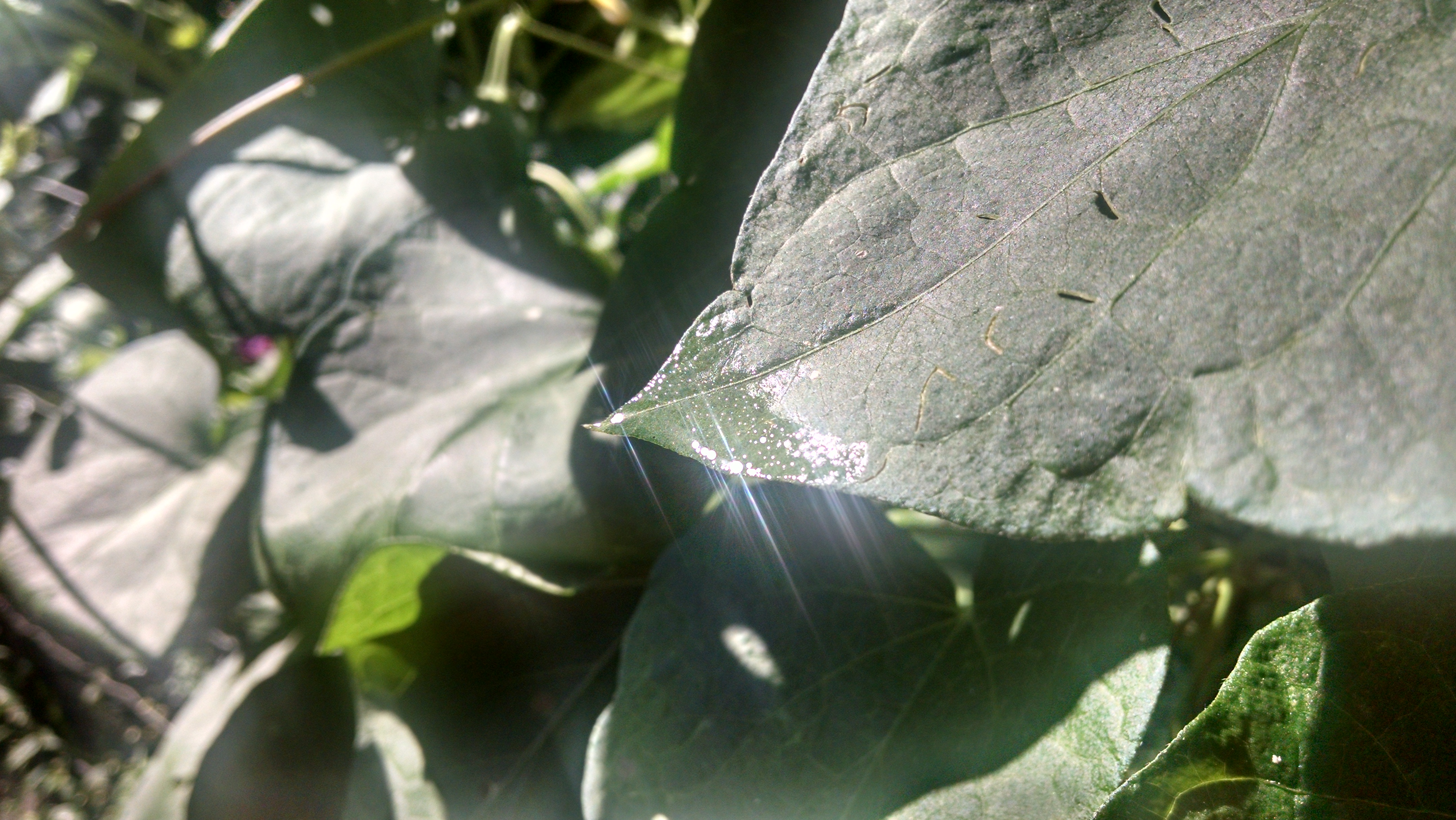
Summer mornings in the Valley are dew-soaked and sparkling. As the sun climbs the arc of the sky, its heat burns away the liquid diamonds. Shaded, they linger for hours, but in the direct light of the sun, the moon’s tears dissipate quickly.

We are the dew of Dickinson’s poem, so certain in our smallness, our ephemerality. We suffice ourselves; we believe we are the answer to our own questions, the center of our own orbits. Like the dew, though, we vanish. What do we leave behind? And where do we go? What happens to the dew? Is it “by day abducted”–does it evaporate back into the same changeless cycle, or will it at last find the sea?

That Dickinson uses the phrase “in passing” suggests that the sun’s dropping of the dew into the sea is a casual gesture, offhanded. The dew that was so sufficient unto itself is, to the sun, a literal drop in the ocean. A drop of dew, to itself, is everything. In the vastness of the sea, it becomes nothing, eternally unknown.

And yet what is the sea but drops of water, gathered together from across a spinning planet, across lifetimes and ages, across space and time, all things coming together in one great final infinity?

The Ocean

An everywhere of silver,
With ropes of sand
To keep it from effacing
The track called land.

~Emily Dickinson

A riddle–not even a complete sentence, but a suggestive fragment, in Dickinson’s characteristic painterly style with words. The ocean is an everywhere, a water planet, though we land-dwelling creatures tend to forget this. It is only a narrow band of sand that separates the realm of the mermaids from our own narrow track.

the Atlantic at twilight

No notice was to me…

Two Butterflies went out at Noon—
And waltzed above a Farm—
Then stepped straight through the Firmament
And rested on a Beam—


And then—together bore away
Upon a shining Sea—
Though never yet, in any Port—
Their coming mentioned—be—


If spoken by the distant Bird—
If met in Ether Sea
By Frigate, or by Merchantman—
No notice—was—to me—

~Emily dickinson

Butterfly season has begun. The little pale-violet moths appeared first, their color scarcely a whisper above white. Next, a larger orange and black-veined butterfly, and then a black one with shimmering blue spots. How ephemeral they are, how delicate–the wind or a small bird’s beak can destroy them. Yet they persist, somehow, eternal despite their fragility. Their coming feels momentous as the arrival of a queen after winter’s frigid dry air and short days. When they disappear into an impossibly blue sky, are they ever really gone, or do they transcend all of it, this warming spring day, this greening field, this world perched forever on the brinks of seasons?

Possibility

CV
THE GRAVE my little cottage is,
Where, keeping house for thee,
I make my parlor orderly,
And lay the marble tea,
For two divided, briefly,
A cycle, it may be,
Till everlasting life unite
In strong society.

~Emily Dickinson

Today’s poem contains a clue to our next idea for a creative collaboration (hint: it’s not a funeral parlor). It’s funny and magical and wondrous how one creative endeavor often begets another. We’re kicking around ideas for an exciting new project. Watch this space…

A not-so-secret conversation

SOME things that fly there be,—
Birds, hours, the bumble-bee:
Of these no elegy.
Some things that stay there be,—
Grief, hills, eternity:
Nor this behooveth me.
There are, that resting, rise.
Can I expound the skies?
How still the riddle lies!

~Emily Dickinson

Editor’s Note:  This conversation has been heavily hacked in the interest of anyone  making any sense of it. Topics edited from this transcript include but are by  no means limited to Anglo-Saxon riddles, Brenna’s theatrical angst, the epic saga of Pam reading a  biography of Hamilton, a book that Pam actually did finish reading but isn’t sure she should have, the resulting excoriation of books about blonde Amazons, and nicknames referencing fish.

Pam: My first question is this: why did we choose this poem?

Brenna: We chose this poem because I flipped through the book and landed on it.

Pam: The secret of this poem is that it is a Carrollesque riddle. So chance is laughing at us.

Brenna: Okay, full disclosure: I chose this poem because I don’t understand it. As of this point, I have two different criteria for selecting E. D. poems: 1) the poem somehow fits the specific day/month/season, or 2) I don’t get it and I am really, really hoping you will explain it to me.

Pam: I chose yesterday’s poem because I wanted a sunny poem. I do not understand this one at all. BUT. Shall we attempt to come up with plausible explanations which cannot be proven at all?

Brenna: Sure! SO. Poem. Who titled this poem? Did E.D. title it? Or was it retroactively titled? Either way, it feels like some kind of smug joke. The title, that is. “I have a secret, but I’m not telling you! Especially NOT in this poem!”

Pam: The secret is that you will NEVER understand this poem.

Brenna: Oh, okay. I think you’ve got it. CASE CLOSED.

Pam: Some things fly: birds, hours, bees. Of these, she’s not writing any elegy; she’s not mourning them. Or somebody isn’t writing an elegy. Either the author is personally not mourning them, or the author is noting that these things are not mourned after they’ve departed.

Brenna: Or she’s not memorializing or reflecting on them. “Elegy” can be a lament, but doesn’t have to be, according to my just-now super-sketch Google analysis. Maybe, because they’re fleeting, she’s not going to dwell on them?

Pam: Elegy doesn’t have to be a reflection on the dead . . . but it’s usually a reflection on the dead.

Brenna: True–and birds, hours, bees all die quickly. They’re sort of defined by their ephemeral nature. “Birds, hours, bees–meh. Why would I write of such things? (despite the fact that this is literally what I write about).”

Pam: Stanza 2: some things remain forever; grief, hills, eternity. “Nor this behooveth me”: this is not my responsibility. But what isn’t her responsibility? The elegy from the first stanza? Eternity?

Brenna: I think she’s dismissing the things in stanzas 1 and 2 equally.

Pam: There’s no point mourning things that die, or time that has passed, because that’s how those things work. There’s no point in worrying about the length of grief or the prospect of eternity because you can’t change those, either.

Brenna: Stanza 3: “There are, that resting, rise”–she is deliberately leaving out the subject of the sentence.It’s a secret, a mystery. [shakes fist in general direction of Amherst]

Pam: She is deliberately being a jerk.

Brenna: Such a jerk. E.D., Mean-girl.

Pam: Mean-girl OG. But it’s Dickinson. Rest. Rest in peace? We’re talking about dead spirits who have risen, perhaps? Can she explain the skies? No, she cannot.

Brenna: Does she herself not know the answer? Maybe she’s not being mean or smug or secretive–maybe she’s struggling to express the inexpressible.

Pam: How still the riddle lies: this, for me, ties into the “rest” in the first line of this stanza. The riddle is death, or what happens to the soul afterward; the riddle is thereby still because the body is dead and unmoving. Perhaps a little bit of “why am I trying to explain this when it’s inexplicable? Why am I trying to figure this out when it’s unknowable?” “Still” is also in contrast to all of the things in stanza one–bees, birds, time. But: can grief die? Can hills? Can immortality? Is that the riddle? I love trying to figure these out, but I also feel a little bit like I’m in the labyrinth and I’ve run out of string, so I must go back to the beginning without having located the center.

Brenna: My brain hurts.

Pam: I feel like we need to add in a Dickinson biography to this project!

Brenna: I want to say that this is a good idea, but I am afeard. But we should read a Dickinson biography. We should. Should should should.

Pam: We should! But will we?

Brenna: YOU KNOW US SO WELL.