Shipwreck

IT tossed and tossed,—
A little brig I knew,—
O’ertook by blast,
It spun and spun,
And groped delirious, for morn.

It slipped and slipped,
As one that drunken stepped;
Its white foot tripped,
Then dropped from sight.

Ah, brig, good-night
To crew and you;
The ocean’s heart too smooth, too blue,
To break for you.

~Emily Dickinson

Image via Pexels.com

Dickinson’s oeuvre is full of shipwreck poems. A ship is always a good metaphor, and she uses them frequently. So, November is shipwreck month here at The Emily Project. This is the season of hurricanes and storms. Last night, the wind rose and knocked everything about the yard. It was a veritable tempest for Halloween night.

In this poem, the storm has overwhelmed the ship that seems “drunk” and “delirious” from its battle with the waves. The last stanza is where Dickinson really gets to the meat of this poem–the ocean (nature? the divine??) doesn’t really care about any of us. We are insignificant, in the grand scheme of things. Yet that hasn’t stopped the speaker from valuing the little craft and its crew, their struggles on the deep. The meaning we find in our lives is meaning we make for ourselves, not anything conferred upon us from without. The universe may not note or care what we do, but we can value human effort and struggle, and feel for those who are lost.

If I may have it when it’s dead


If I may have it, when it’s dead,
I’ll be contented—so—
If just as soon as Breath is out
It shall belong to me—

Until they lock it in the Grave,
‘Tis Bliss I cannot weigh—
For tho’ they lock Thee in the Grave,
Myself—can own the key—

Think of it Lover! I and Thee
Permitted—face to face to be—
After a Life—a Death—We’ll say—
For Death was That—
And this—is Thee—

I’ll tell Thee All—how Bald it grew—
How Midnight felt, at first—to me—
How all the Clocks stopped in the World—
And Sunshine pinched me—’Twas so cold—

Then how the Grief got sleepy—some—
As if my Soul were deaf and dumb—
Just making signs—across—to Thee—
That this way—thou could’st notice me—

I’ll tell you how I tried to keep
A smile, to show you, when this Deep
All Waded—We look back for Play,
At those Old Times—in Calvary,

Forgive me, if the Grave come slow—
For Coveting to look at Thee—
Forgive me, if to stroke thy frost
Outvisions Paradise!

~Emily Dickinson

One last creepy poem for your Halloween reading–enjoy!

The pantomime

I breathed enough to learn the trick,
And now, removed from air,
I simulate the breath so well,
That one, to be quite sure

The lungs are stirless, must descend Among the cunning cells,
And touch the pantomime himself.
How cool the bellows feels!

~Emily Dickinson

In this poem, the speaker describes herself as lifeless, though of course she is alive. Dickinson seems to be describing a deep depression, the kind that makes one feel dead while still technically living.

This, I think, is the official take on this poem. What’s interesting to me, though, obsessed as I am at the moment with all things spooky and eerie, is all the details that suggest that she really is not alive–that we’re listening to a ghost.

She tells us that she did breathe, once, but is now “removed from air.” In the second stanza she insists that she looks so alive that one “must descend” into the cells of her lungs to realize that she is not, in fact, actually breathing. She is a pantomime of human life, her “bellows” “cool” to the touch.

Sounds like a ghost to me.

That dark parade

THERE’S been a death in the opposite house
As lately as to-day.
I know it by the numb look
Such houses have alway.

The neighbors rustle in and out, 5
The doctor drives away.
A window opens like a pod,
Abrupt, mechanically;

Somebody flings a mattress out,—
The children hurry by; 10
They wonder if It died on that,—
I used to when a boy.

The minister goes stiffly in
As if the house were his,
And he owned all the mourners now, 15
And little boys besides;

And then the milliner, and the man
Of the appalling trade,
To take the measure of the house.
There ’ll be that dark parade 20

Of tassels and of coaches soon;
It ’s easy as a sign,—
The intuition of the news
In just a country town.

~Emily Dickinson

There is so, so much very deeply creepy stuff going on in this poem.

It’s frequently anthologized, but I know it best by just that first line. I didn’t remember all the disturbing detail from my past encounters with this poem–just that first line. The first stanza is interesting, with its suggestion that what transpires within a house affects the appearance of its exterior. This works on a symbolic level, too–what happens within us can be written on our faces, or at least give off a feel that hints at what’s going on inside.

The second and third stanzas, though, are where things really start to get dark. The second stanza ends with a window opening “like a pod,” and I am too much a product of my times not to imagine some kind of sci-fi business there. In the third stanza, the mattress of the deceased goes flying out that window, and the speaker identifies with children wondering “if It died on that.” Shudder. The dehumanizing of the dead person is brief but chilling. And then we learn that the speaker, in a rare twist from Dickinson’s usual M.O., is male.

Then we get the litany of the folks in all the death-related trades who enter the house, and things do not get less unsettling. The minister goes in as if he owns the house, mourners, and all the little boys, too. The milliner (why do we need a hat??) and “the man/Of the appalling trade,” presumably the funeral director, then enter.

The speaker ends by imagining the “dark parade” that is about to transpire, and then pulls back the focus by presenting this as just one of many such incidents “in just a country town.”

In many of Dickinson’s poems about the deaths of individuals, the focus is entirely on the deceased and that person’s impact on those s/he left behind. This poem is different–the deceased is never even really described as human. The entire thrust of the poem is toward the wrongness of death, the dehumanization of it.

It’s a disturbing poem on many levels.

Spirit

’T IS whiter than an Indian pipe,
’T is dimmer than a lace;
No stature has it, like a fog,
When you approach the place.

Not any voice denotes it here,
Or intimates it there;
A spirit, how doth it accost?
What customs hath the air?

This limitless hyperbole
Each one of us shall be:
‘T is drama, if (hypothesis)
It be not tragedy!

~Emily Dickinson
An “Indian pipe” in the woods behind my house.

I just got back from a conference in New York and am struggling to keep my head above water both at work and at home, so today you get a poem and a picture. Enjoy!

Though pyramids decay

’T is an honorable thought,
And makes one lift one’s hat,
As one encountered gentlefolk
Upon a daily street,

That we ’ve immortal place,
Though pyramids decay,
And kingdoms, like the orchard,
Flit russetly away.

~Emily Dickinson
Image via Pexels.com

This poem has some things to say to this other poem, so I’ll just put them both here and let them talk it out. The following poem has chatted with Dickinson’s work here before, but I need pretty much no excuse to reread “Ozymandias” for the gazillionth time.

I met a traveller from an antique land,
Who said—“Two vast and trunkless legs of stone
Stand in the desert. . . . Near them, on the sand,
Half sunk a shattered visage lies, whose frown,
And wrinkled lip, and sneer of cold command,
Tell that its sculptor well those passions read
Which yet survive, stamped on these lifeless things,
The hand that mocked them, and the heart that fed;
And on the pedestal, these words appear:
My name is Ozymandias, King of Kings;
Look on my Works, ye Mighty, and despair!
Nothing beside remains. Round the decay
Of that colossal Wreck, boundless and bare
The lone and level sands stretch far away.”

~Percy Bysshe Shelley

Bat

Image via Pexels.com

THE BAT is dun with wrinkled wings
Like fallow article,
And not a song pervades his lips,
Or none perceptible.

His small umbrella, quaintly halved, 5
Describing in the air
An arc alike inscrutable,—
Elate philosopher!

Deputed from what firmament
Of what astute abode, 10
Empowered with what malevolence
Auspiciously withheld.

To his adroit Creator
Ascribe no less the praise;
Beneficent, believe me, 15
His eccentricities.

~Emily Dickinson

I love all of Dickinson’s advocation for the creepy critters amongst us. Her descriptions are spot-on and delightful. My favorite is of the bat in flight as a “small umbrella, quaintly halved.” The bat is an “Elate philosopher,” and while he is “empowered with…malevolence,” he withholds it. The Creator of the bat deserves praise for this creation as well as others. Dickinson ends on the notion that the oddness of creation is goodness, and I could not agree more.

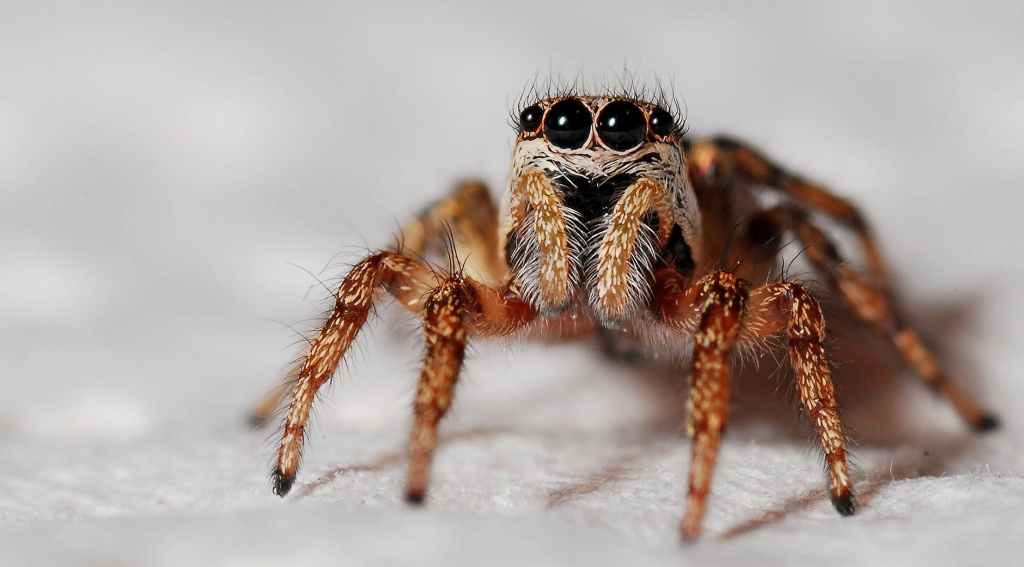
Spider

The spider as an artist
Has never been employed
Though his surpassing merit
Is freely certified

By every broom and Bridget Throughout a Christian land.
Neglected son of genius,
I take thee by the hand.

~Emily Dickinson
I mean. Look at thos eyelashes. ❤
Image via Pexels.com

Dickinson does not shy away from critters that make others squirm. In that sense, this poem recalls “A narrow fellow in the grass.” But it’s quite different, aside from taking on a subject that squicks out many people.

The first stanza establishes the spider as an artist. The speaker goes on to argue that the worth of the spider is proved by brooms and those who wield them. It’s a fun little tongue-in-cheek moment–the playful side of Dickinson that is often present but that doesn’t seem to get as much attention as the angst because angst is Serious Literary Business.

The final image of Dickinson taking the spider by the hand is similarly playful, and her final epithet for the creature is marvelous–“neglected son of genius.” This is some much-needed spider appreciation, and I am here for it.

Bone

Image via Pexels.com

The bone that has no marrow;
What ultimate for that?
It is not fit for table,
For beggar, or for cat.

A bone has obligations,
A being has the same;
A marrowless assembly
Is culpabler than shame.

But how shall finished creatures
A function fresh obtain?—
Old Nicodemus’ phantom
Confronting us again!

~Emily Dickinson

Hmm…I don’t know?? “The bone that has no marrow” seems like maybe outer appearance without substance. Something hollow that should be full. A bone without marrow is not nourishment–it’s jut a bone. No one can get anything out of it.

In the second stanza, Dickinson moves from the example of the bone to what it represents–bones are obligated to contain marrow, just as beings are obligated to perform certain functions. “Marrowless” people are at fault for their own hollowness, she seems to be saying.

Is there a possibility of redemption? Can “finished creatures” achieve a new purpose if they’re already lacking marrow, substance? She doesn’t overtly offer an answer, but ends with “Old Nicodemus’ phantom.” Perhaps this is the answer–a resounding no. One who is hollow is a phantom.

How to be forgotten

AFTER a hundred years
Nobody knows the place,—
Agony, that enacted there,
Motionless as peace.

Weeds triumphant ranged, 5
Strangers strolled and spelled
At the lone orthography
Of the elder dead.

Winds of summer fields
Recollect the way,— 10
Instinct picking up the key
Dropped by memory.

~Emily Dickinson

It’s simple, really. Just let a hundred years pass. In a hundred years, the scenes of our suffering will be sanded down by time, glossed over, our traces removed. No one will know, remember. A few may guess, but certainty ended a long time ago.

The places that marked the unforgettable moments of our lives become overgrown, naturalized to their former wildernesses. The last vestiges of our existences, if such remain, are curiosities merely, a line to be idly wondered at, a few lost grave goods.

The wind, perhaps, carries a sense of what went before. Now, when we pass a place where great joy, great sorrow, great intensity of emotion has occurred, we hesitate, a few of us. There is a tinge of something on the breeze, a suggestion. A prickling at the back of the neck. A sudden incalculable rush of feeling. Signs that someone was here, once.

In a hundred years, someone else will perhaps wonder the same thing.