If I may have it when it’s dead


If I may have it, when it’s dead,
I’ll be contented—so—
If just as soon as Breath is out
It shall belong to me—

Until they lock it in the Grave,
‘Tis Bliss I cannot weigh—
For tho’ they lock Thee in the Grave,
Myself—can own the key—

Think of it Lover! I and Thee
Permitted—face to face to be—
After a Life—a Death—We’ll say—
For Death was That—
And this—is Thee—

I’ll tell Thee All—how Bald it grew—
How Midnight felt, at first—to me—
How all the Clocks stopped in the World—
And Sunshine pinched me—’Twas so cold—

Then how the Grief got sleepy—some—
As if my Soul were deaf and dumb—
Just making signs—across—to Thee—
That this way—thou could’st notice me—

I’ll tell you how I tried to keep
A smile, to show you, when this Deep
All Waded—We look back for Play,
At those Old Times—in Calvary,

Forgive me, if the Grave come slow—
For Coveting to look at Thee—
Forgive me, if to stroke thy frost
Outvisions Paradise!

~Emily Dickinson

One last creepy poem for your Halloween reading–enjoy!

The pantomime

I breathed enough to learn the trick,
And now, removed from air,
I simulate the breath so well,
That one, to be quite sure

The lungs are stirless, must descend Among the cunning cells,
And touch the pantomime himself.
How cool the bellows feels!

~Emily Dickinson

In this poem, the speaker describes herself as lifeless, though of course she is alive. Dickinson seems to be describing a deep depression, the kind that makes one feel dead while still technically living.

This, I think, is the official take on this poem. What’s interesting to me, though, obsessed as I am at the moment with all things spooky and eerie, is all the details that suggest that she really is not alive–that we’re listening to a ghost.

She tells us that she did breathe, once, but is now “removed from air.” In the second stanza she insists that she looks so alive that one “must descend” into the cells of her lungs to realize that she is not, in fact, actually breathing. She is a pantomime of human life, her “bellows” “cool” to the touch.

Sounds like a ghost to me.

Bat

Image via Pexels.com

THE BAT is dun with wrinkled wings
Like fallow article,
And not a song pervades his lips,
Or none perceptible.

His small umbrella, quaintly halved, 5
Describing in the air
An arc alike inscrutable,—
Elate philosopher!

Deputed from what firmament
Of what astute abode, 10
Empowered with what malevolence
Auspiciously withheld.

To his adroit Creator
Ascribe no less the praise;
Beneficent, believe me, 15
His eccentricities.

~Emily Dickinson

I love all of Dickinson’s advocation for the creepy critters amongst us. Her descriptions are spot-on and delightful. My favorite is of the bat in flight as a “small umbrella, quaintly halved.” The bat is an “Elate philosopher,” and while he is “empowered with…malevolence,” he withholds it. The Creator of the bat deserves praise for this creation as well as others. Dickinson ends on the notion that the oddness of creation is goodness, and I could not agree more.

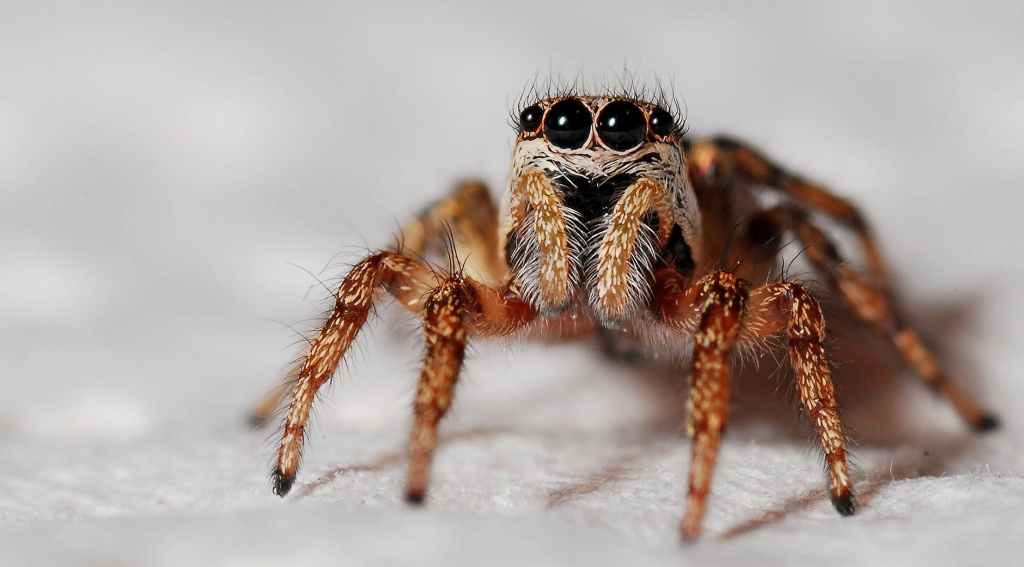
Spider

The spider as an artist
Has never been employed
Though his surpassing merit
Is freely certified

By every broom and Bridget Throughout a Christian land.
Neglected son of genius,
I take thee by the hand.

~Emily Dickinson
I mean. Look at thos eyelashes. ❤
Image via Pexels.com

Dickinson does not shy away from critters that make others squirm. In that sense, this poem recalls “A narrow fellow in the grass.” But it’s quite different, aside from taking on a subject that squicks out many people.

The first stanza establishes the spider as an artist. The speaker goes on to argue that the worth of the spider is proved by brooms and those who wield them. It’s a fun little tongue-in-cheek moment–the playful side of Dickinson that is often present but that doesn’t seem to get as much attention as the angst because angst is Serious Literary Business.

The final image of Dickinson taking the spider by the hand is similarly playful, and her final epithet for the creature is marvelous–“neglected son of genius.” This is some much-needed spider appreciation, and I am here for it.

Necromancer, landlord

What inn is this
Where for the night
Peculiar traveller comes?
Who is the landlord?
Where the maids?
Behold, what curious rooms!
No ruddy fires on the hearth,
No brimming tankards flow.
Necromancer, landlord,
Who are these below?

~Emily Dickinson
Image via Pexels.com

When this project began, I knew Emily Dickinson was into death, but I had no idea just how good she was at being creepy. This poem is no exception. I assume this poem is about death/the grave, but my imagination keeps snagging on the phrase “Necromancer, landlord.” A necromancer is someone who communicates with the dead as a magical practice, presumably a living someone. Is the necromancer the keeper of the graveyard? Or someone/something more nebulous? Who knows? What I do know is that the image of the necromantic keeper of this macabre hotel “below” makes for a wonderfully creepy poem.

One need not be a chamber to be haunted

One need not be a chamber to be haunted,
One need not be a house;
The brain has corridors surpassing
Material place.

Far safer, of a midnight meeting External ghost,
Than an interior confronting
That whiter host.

Far safer through an Abbey gallop,
The stones achase,
Than, moonless, one’s own self encounter
In lonesome place.

Ourself, behind ourself concealed,
Should startle most;
Assassin, hid in our apartment,
Be horror’s least.

The prudent carries a revolver,
He bolts the door,
O’erlooking a superior spectre
More near.

~Emily Dickinson
Image via Pexels.com

I have very little to say about this one. It’s perfect, really, and completely true. We are the most terrifying spectres we will ever meet. Humans can be haunted by the past, by the undone, by the unrealized. Our minds are more expansive than any construction, and so are vastly more capable of housing ghosts. The lines about encountering oneself in a lonesome place on a moonless night are especially vivid. We hide our true selves behind our external selves, and what we carry inside us should concern us more than any outer threat.

Though I doubt Dickinson was thinking specifically about writing and scary stories with this one, it also works on that kind of meta-level–we carry within us all the scary stories we are capable of creating.

Lonely houses

I KNOW some lonely houses off the road
A robber ’d like the look of,—
Wooden barred,
And windows hanging low,
Inviting to 5
A portico,

Where two could creep:
One hand the tools,
The other peep
To make sure all ’s asleep. 10
Old-fashioned eyes,
Not easy to surprise!

How orderly the kitchen ’d look by night,
With just a clock,—
But they could gag the tick, 15
And mice won’t bark;
And so the walls don’t tell,
None will.

A pair of spectacles ajar just stir—
An almanac’s aware. 20
Was it the mat winked,
Or a nervous star?
The moon slides down the stair
To see who ’s there.

There ’s plunder,—where? 25
Tankard, or spoon,
Earring, or stone,
A watch, some ancient brooch
To match the grandmamma,
Staid sleeping there. 30

Day rattles, too,
Stealth ’s slow;
The sun has got as far
As the third sycamore.
Screams chanticleer, 35
“Who ’s there?”

And echoes, trains away,
Sneer—“Where?”
While the old couple, just astir,
Think that the sunrise left the door ajar!

~Emily Dickinson

So begins a very October series of poems–Dickinson on the creepy, the macabre, the night-dwelling creatures, in honor of the spookiest month of the year.

I cannot adequately express how much I love this poem. This is the Dickinson poem I had no idea I needed. It’s deliciously creepy, linguistically playful, and just generally delightful.

This poem seems to represent a whole other side of Dickinson. The sight of “lonely houses” far from the road leads her into a dark little thought-experiment in which she at times seems to be imagining the scene from the perspective of the robber. This is definitely not what I was ever taught about Dickinson in school, and I love how unexpected it is.

She sets the scene so well–the lonely houses, the robber creeping in, the silence threatened by the smallest of sounds, the elderly couple asleep, in peril. What Dickinson is this??

What follows is even better–Dickinson’s wildly inventive use of language to personify the objects and creatures in the house: the gagged clock, the barking mouse, the stirring spectacles, the aware almanac, winking mat, nervous star, and that gorgeous image of the moon sliding “down the stair.” And then that final description of the old couple waking to find the door ajar and surmising that it was the sunrise who left it thus.

The structure is fun, too–uneven line lengths mimicking the tentative steps of the pair of robbers as they strive not to wake the old couple and alert their sentient possessions; and the final stanza, which has one less line than all the rest, as if the robbers have stolen that along with tankard, spoon, and antique jewelry.

I seriously cannot get enough of this poem. I keep reading and rereading it, struck each time by the nuances of some little detail or other, as well as by the entire mood of it, and the sheer unexpectedness of it. It’s a perfect October poem–though Dickinson never mentions the season, it feels like it has to be autumn.

Coming up this month–bats, mice, mushrooms, spiders, ghosts, cobwebs, spirits, graves, and, of course, death. Because Emily Dickinson.